An interactive explainer
A Universe in a Row of Cells
In the early 1980s, a young physicist named Stephen Wolfram began studying the simplest programs he could imagine: a single row of black and white cells, changing step by step under one tiny rule. Some of these little worlds die out. Some settle into perfect rhythm. And a few erupt into something so rich it looks alive.
Every diagram on this page is computed live, cell by cell, as you read
Part 1 · The setup
The simplest world you can imagine
Here is an entire universe: one row of cells, where each cell is either black or white. That is everything. No physics, no chemistry, no DNA — just a line of cells, each one either filled in or empty.
Time in this universe moves in steps, like generations. When a step passes, every cell in the row is replaced by a new cell, and the new row is printed directly below the old one. The picture that grows down the page is the history of the world — the top row is the beginning, and every row below it is one generation later. Read it the way you would read tree rings or layers of rock.
One note on words: Wolfram, a physicist, calls each new row a “step.” This page will mostly say “generation” — because what we are here to watch is the life in these pictures.
- The top row is the beginning. Here, a single black cell in a sea of white.
- Each new row is the next generation, printed below the one before it.
- Read downward. The whole picture is the world's history, from its first moment to its latest.
Part 2 · The rule
One tiny rule decides everything
How does a cell decide its color in the next generation? It looks at exactly three cells in the row above: the cell directly above it, and the two neighbors on either side of that cell. Those three are its parents, and their colors completely determine the child's color. Nothing else in the universe has any say.
Three parents, each black or white, can appear in 2 × 2 × 2 = 8 possible combinations. A rule is simply a complete answer sheet: for each of the eight combinations, will the child be black, or white?
Eight answers, each with two choices, gives 2⁸ = 256 possible rules — every possible universe of this kind, and you could write any one of them on the back of your hand. Wolfram numbered them 0 through 255 by reading the eight answers as a binary number. The rule below spells 00011110, which is the number 30 — so it is called Rule 30, and it is the most famous of them all.
Part 3 · Press play
Three worlds, same beginning
Let us start every world the same way: one single black cell, the simplest possible seed. Here are three of the 256 rules, given exactly the same start. Watch what each one grows into.
Part 4 · The four fates
Every world meets one of four fates
Wolfram then did what a naturalist would do: he ran all 256 rules and simply watched them, like an explorer cataloguing new species. This time the worlds begin not from one cell but from a random row — a wild scatter of black and white, like a full population instead of a single ancestor.
Nearly everything he saw fell into just four families of behavior. He called them Class 1 through Class 4 — a classification he first worked out in 1983, the way earlier scientists sorted matter into solids, liquids, and gases. You can think of them as four fates.
It fizzles out
Whatever pattern you start with dies away, and the world freezes into a single color, forever. Extinction. (Note that freezing into all-black is still extinction — total sameness either way, with no memory that anything ever happened.)
It settles down
The world finds a stable arrangement — unmoving stripes, or a steady repeating heartbeat — and stays there forever. Life, but frozen into routine: like a species perfectly fitted to its niche that never changes again.
It churns forever
The world boils with activity that never settles and never repeats. Any structure that appears is torn apart within a few generations. It looks — and in a measurable sense, is — random, even though every single cell is following the rule exactly.
It comes alive
The rarest and most remarkable fate. Order and chaos coexist: the world develops little structures that hold together, travel, collide, pass through each other, and destroy or create one another — like particles, or like organisms. Watching a Class 4 rule feels less like watching static and more like watching an ecosystem. Rule 110 is the class's certain member; Wolfram suspects Rule 54 belongs here too, though he is careful to say he is not sure.
A word of honesty about the biology in this language: nothing here mutates, competes, or is selected, so this is not Darwinian evolution. But these little worlds answer a question that evolution also raises — where does complexity come from? — and their answer is startling: it can come from almost nothing.
Part 5 · Destiny and details
Does the beginning matter?
Maybe Rule 30's wildness came from a lucky starting row? Run it three times from three completely different random beginnings. The details differ in every run — but the character is identical. The fate belongs to the rule, not to the seed.
And yet the details matter enormously — just not in the way you might think. Below, two copies of Rule 30 were started with rows that differ by one single cell. The colored region marks every cell where their futures disagree.
Part 6 · Portrait
Rule 30, the wild one
Rule 30 deserves a closer look, because it carries the deepest shock of the whole subject: a perfectly simple, perfectly known rule producing behavior that passes every practical test of randomness. There is no hidden noise, no dice being rolled anywhere — and yet the middle of this pattern is so unpredictable that for many years Wolfram's own software, Mathematica, generated its random numbers by running Rule 30 and reading off the center of the pattern.
That center column holds real, open mysteries. In 2019 Wolfram announced $30,000 in prizes for three questions about it: Does the column ever fall into repetition? Do black and white appear in it equally often, in the long run? And is there any way to compute its millionth entry faster than simply running the rule a million generations? All three questions remain unanswered.
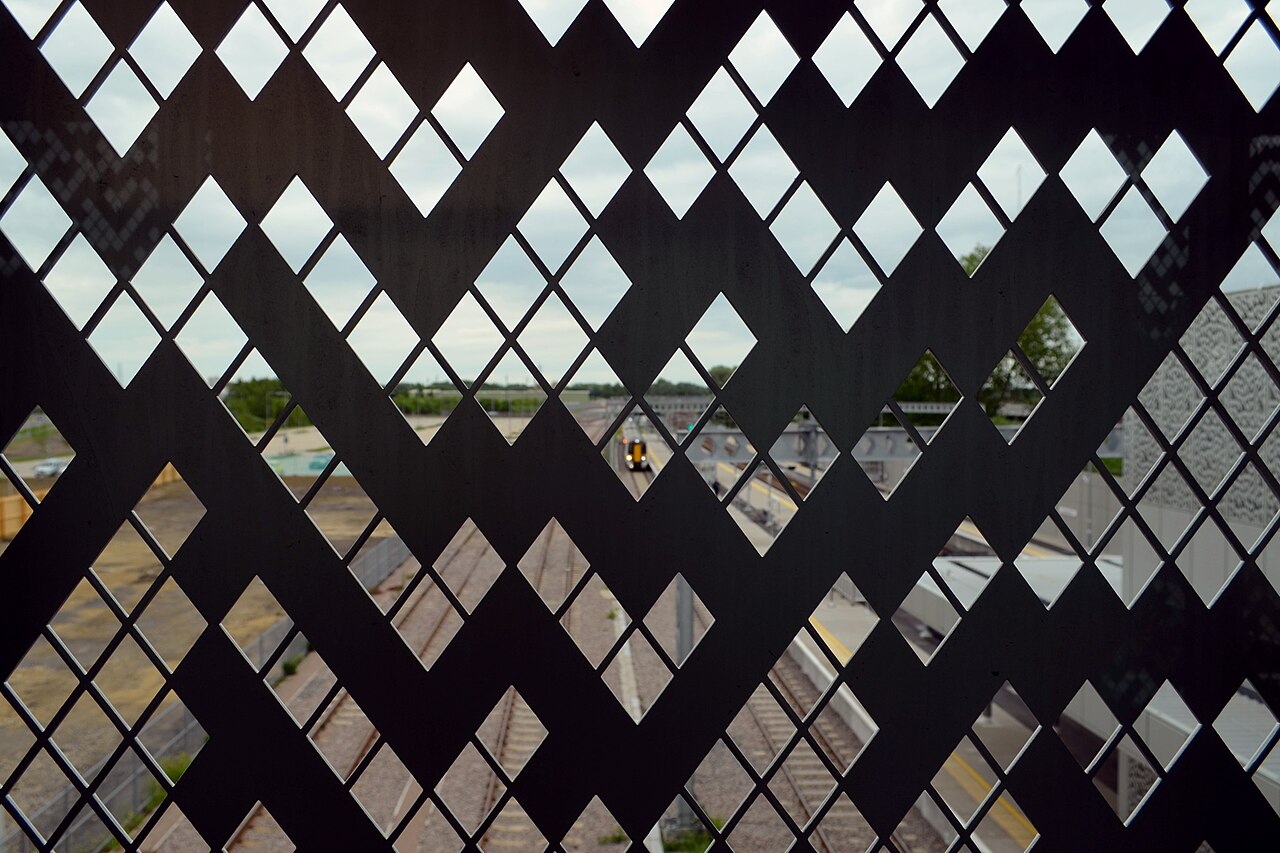
Rule 30 has even escaped into architecture. Cambridge North railway station, in England, is wrapped in aluminum panels perforated with a pattern taken directly from Rule 30's evolution. Wolfram — delighted — pointed out that since the pattern reads one way in daylight and inverts when the holes glow at night, the building displays a black-and-white-swapped cousin of the rule by day, and Rule 30 itself after dark.
And nature seems to have found this trick long before we did. The shell of a living cone snail is built by a row of pigment cells along its growing edge — a physical row of cells, deciding step by step how to color the next sliver of shell. The finished shell is the printed history of that row, exactly like the diagrams on this page. In his book, Wolfram places photographs of these shells beside cellular automaton diagrams, and it is genuinely hard to tell which is which. A snail, in other words, may be wearing one of these pictures.
Part 7 · Portrait
Rule 110, the one that computes
Among the Class 4 rules, one turned out to hold the biggest prize in the whole collection. In Rule 110, the little traveling structures — researchers call them gliders — move across a patterned background, collide, and transform one another in reliable, repeatable ways.
If collisions are reliable, you can use them. Arrange the right gliders in the right starting row and their collisions can act like the logic inside a computer chip — signals meeting, combining, producing new signals. Pushing this idea to its limit leads to an astonishing theorem: with the right starting row, Rule 110 can perform any computation that any computer can perform. Your laptop, in principle, could be emulated — slowly! — by this one row of cells and its eight answers. Wolfram began to suspect this as early as 1985; the proof was worked out in 1994 by Matthew Cook, a young researcher working with him, and published in the early 2000s. It makes Rule 110 one of the simplest systems ever shown to be a universal computer.
Sit with that for a moment: the full power of computation, hiding inside a rule you could teach to a child in a minute.
Part 8 · Why it matters
What these little worlds are telling us
You cannot skip to the end
For the interesting rules, there is no formula that jumps ahead. If you want to know what Rule 30 looks like at generation one million, the only known way to find out is to compute all one million generations, one by one. Wolfram calls this computational irreducibility: the system's own step-by-step unfolding is the fastest possible description of it. There is no summary, no shortcut, no spoiler. If nature works this way too — and Wolfram argues it often does — then the unpredictability of weather, ecosystems, and history is not a failure of our science. It may be a permanent feature of any universe rich enough to be interesting.
Complexity is cheap
Before these experiments, it was natural to assume that complicated things need complicated causes — that something as intricate as a seashell's pattern, or a snowflake, or an organism, must be built from an equally intricate blueprint. The 256 little universes say otherwise. Eight yes-or-no answers are enough to produce endless novelty, structure, motion, even computation itself. Complexity does not need a complicated cause. For biology, that is a quietly liberating idea: evolution does not have to invent complexity from scratch — simple rules generate it for free, and selection can then shape what the rules provide.
Everything computes
Wolfram draws one more, bolder conclusion. Since even the simplest rules reach the maximum possible sophistication — Rule 110 computes anything computable — he proposes that almost every system that is not obviously simple is performing computation of equal power: a principle he calls the Principle of Computational Equivalence. In this view, a turbulent stream, a growing plant, and a human brain are not on a ladder of increasing sophistication; they are all, computationally, doing the same kind of thing. It remains a bold and debated claim — and it grew directly out of watching pictures like the ones on this page.
“It's amazing that a rule so simple can produce behavior that's so complex.”Stephen Wolfram, announcing the Rule 30 Prizes, 2019
Part 9 · Your turn
Run your own universe
There are 256 of these worlds, and you have now met perhaps a dozen. The rest are yours to explore. Pick a rule by number, flip its answers directly, start it from one cell or from randomness — or draw your own first generation and see what fate it meets. (A connoisseur's note: counting mirror images and black-white swaps as the same world, there are exactly 88 truly different rules. Nobody will mind if you visit all 256 anyway.)
When the picture reaches the bottom, it keeps running — the view scrolls upward through the world's history.