An interactive explainer · part three
A Universe in a Garden of Cells
Page one watched a row of cells become a universe. Page two bent that row into a spiral and grew it into a sunflower. Both pages obeyed one law so completely that we never thought to say it out loud: the rule, once chosen, is forever. This page breaks that law — first carefully, then recklessly — until a single seed grows a branching garden in which no cell, once laid, is ever changed.
Every diagram on this page is computed live, cell by cell, as you read
Part 1 · The unspoken law
Two universes, one hidden constant
The short version of the story so far. Page one: a row of black and white cells, each new generation decided by three parents in the row above, eight possible parent-combinations, so a rule is an answer sheet of eight yes-or-no answers — 256 possible rules in all, some boring, some rhythmic, some endlessly chaotic, and one (Rule 110) provably able to compute anything a computer can. Page two: keep the answer sheets, change the world — wind the row into a spiral, lay cells one at a time from a nine-cell seed, let the lattice grow, and finally build it the way a sunflower does. The lesson there: a rule's personality is a partnership between the rule and the world it runs in.
But through every plate on both pages, one thing never changed: the rule itself. Pick rule, press play, never touch it again. Real worlds are not like that. Laws of growth get amended midstream — a seedling becomes a stem becomes a flower, an economy changes regime, a genome switches which of its programs is running. So this page asks the next question in the series: what happens when the rule changes partway through the run?
Two promises before we start. First, nothing new is added to the rules — every plate on this page uses the same 256 numbered answer sheets from page one, and nothing else. Second, a promise inherited from page two and kept everywhere here, even when things get strange: a cell, once laid, is never rewritten. The past stays put. Only the future is up for negotiation.
Part 2 · The switch
Strata — geology in a diagram
Start in page one's world: a loop of cells, generations stacked downward. Run one rule for fifty-five generations. Then, between one drumbeat and the next, swap the answer sheet — every cell, same instant, new law. Nothing else changes. The old rule's last row simply becomes the new rule's starting condition.
The result reads like a road cut through sedimentary rock: layers of different character, each grown directly out of the one beneath. The thin terracotta line marks the moment the law changed.
Is the switched world just some other single rule in disguise? No — and we can say so precisely. Doing "one step of rule A, then one step of rule B" in a single stroke needs to see five cells, not three, so the combined step is generally not one of the 256 elementary rules at all. And for the plate at the top of this section we checked the direct question by brute force: no single rule among all 256 reproduces that switched history — while the history after the line is continued by exactly one rule, 110. The stratum is real. The rock remembers the law that laid it down.
And of course, nothing stops at two layers. A whole schedule of rules — this one for forty generations, that one for the next forty, a third after that — turns the diagram into a stratigraphic column: a program made of programs.
Part 3 · What a switch can buy
Two rules can do what no one rule can
Pretty layers are one thing. Here is the surprise that makes rule-switching more than scenery: there is a job that no single rule can do, and a pair of rules run in sequence does it perfectly.
The job is called density classification, and it sounds trivial: look at a ring of black and white cells and decide which color is in the majority — end all-black if black outnumbers white, all-white otherwise. A vote, counted by physics instead of a clerk. In 1995, Mark Land and Richard Belew proved that no single automaton of this kind can get it right for every starting ring — some voting pattern always fools it. And in 1997, Henryk Fukś published a two-line loophole: run Rule 184, the traffic rule, for roughly half the run… then switch to Rule 232, the majority rule, for the rest. Together, they classify perfectly.
Watch it work, on two rings with opposite majorities:
Why it works is a small mechanical poem. Rule 184 behaves like cars on a road: where black and white are locally mixed, it sorts them into moving streams, and the excess — the surplus votes of the majority — condenses into solid blocks that traffic cannot dissolve. By halfway around the ring, every disguise has been stripped: what remains is majority material, arranged so that Rule 232 — which simply lets each cell side with the local majority of its three parents — can finish the count without ever making a mistake. The first rule prepares; the second rule decides. Neither can do the whole job alone; the theorem says nothing can. The switch is not decoration here. The switch is the algorithm.
Part 4 · Growth rings
Switching rules mid-flower
Now carry the switch into page two's finale: the sunflower lattice, where cells are laid one at a time at the golden angle, each new cell's three parents being the cell laid just before it plus its two nearest older neighbors. There are no generations here to swap between drumbeats — there is only the count of cells laid. So switch on the count: the first four hundred and twenty cells under one rule, every cell after under another.
Because the lattice is laid down in rings, the moment of the switch is not a line but a circle. Inside the dashed ring, one law; outside it, another — with the new rule's parents reaching back across the boundary into the old world, ring by ring, so the outer rule grows out of the inner rule's rim the way each stratum grew from the layer beneath.
The flower that really does switch programs
We called the dashed circle a metaphor, but the metaphor is leaning on something real, and it is worth telling carefully. A sunflower head is built edge-first: the florets at the rim are specified earliest, and construction marches inward — so on a real seed head, radius genuinely is a clock. And the rim runs a different program: a single gene, active only in the outer zone, turns that zone's florets into the showy petal-like ray florets, while the interior grows the tight spiral of fertile disk florets. Botanists have found sunflower varieties where that switch is stuck on everywhere — the whole head grows rays. You have seen the result in a museum: van Gogh's shaggy, double-flowered sunflowers are heads where one zone's law took over the world.
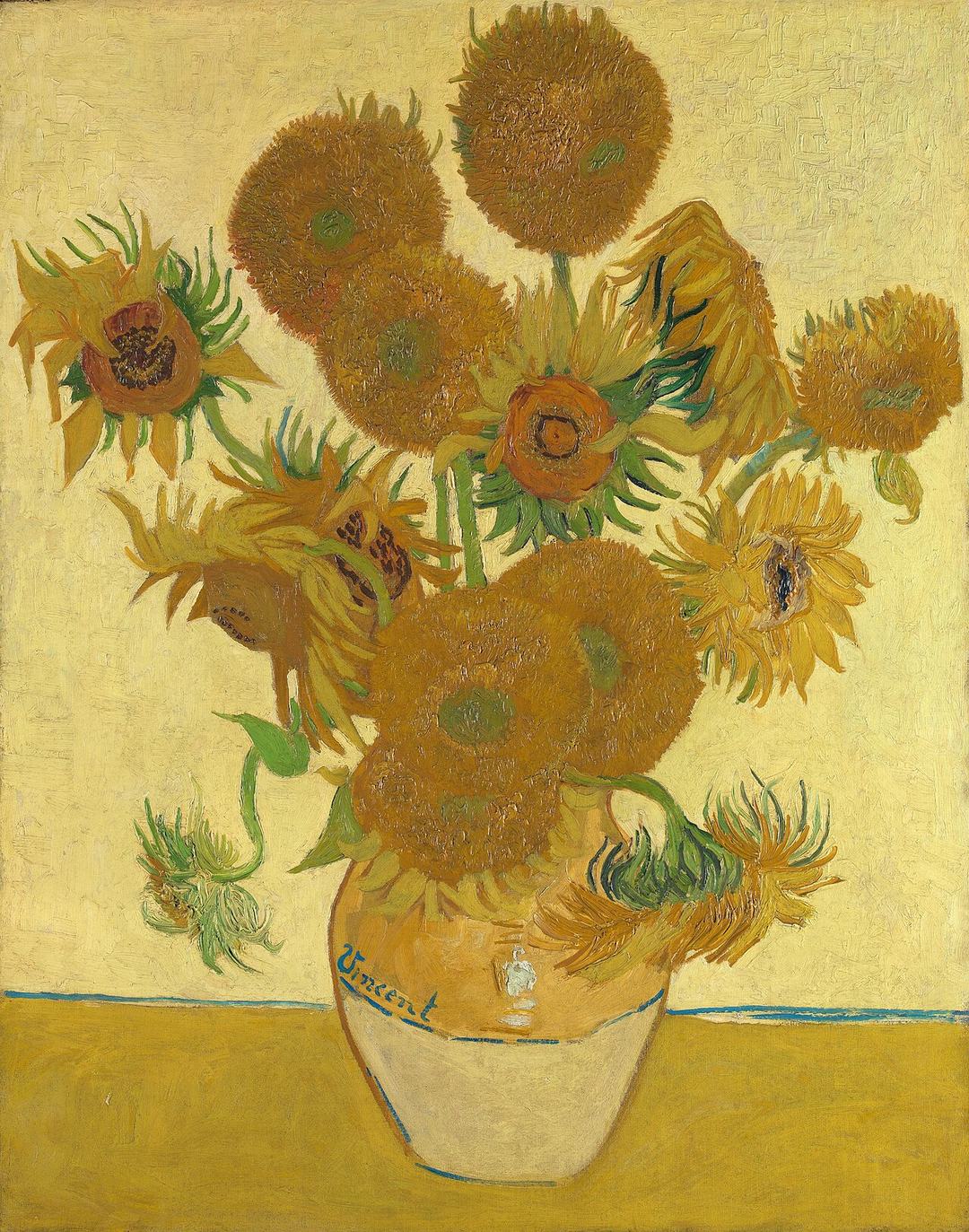
To be honest where honesty is due: a real head does not re-run its florets — their identities are fixed early, by position, and our automaton likewise never touches a laid cell. The switching is in what gets built next. Even the timing has a real echo: when a sunflower blooms, it abandons its smooth spiral construction order and switches to a new regime — one crisp ring of florets opening per day, working inward. A program that changes partway through the run is not our invention. We are late to it by about a hundred million years.
Part 5 · The bud
A switch that plants a new origin
Everything so far changed the law but kept the geography: one center, one spiral, forever. Here is the stranger idea this page was really written for. What if the switch doesn't amend the old world's constitution — what if it founds a colony?
The construction: grow the flower normally to the switch cell. Then stop it, and plant a new origin exactly where the next cell would have gone. From that point a second golden-angle spiral begins — new center, new rule, laying its own cells by its own count. Two laws keep the two worlds honest neighbors. First, the inherited promise: no cell, once laid, is ever rewritten — the new world cannot touch the old one. Second, one new law, almost embarrassingly simple: if a spot the new spiral wants is too close to the old world's cells, the new world simply skips it and moves on to its next position. No collision physics, no forces, no negotiation. Skip and continue.
We expected that skipping rule to be a bookkeeping detail. It turned out to be the whole character of the thing.
- Filled dots are live cells; ink is the parent's world. The parent grows normally to the switch, then stops forever.
- Faint rings are cells laid dead — still real, still parents to later cells, never revisited.
- Terracotta is the bud: a second spiral under its own rule, growing from its own origin (the small marked circles). The tint marks who laid the cell — states here are still only on or off.
Look at the shape the bud takes. Nobody told it to lean away from its parent. Its instructions say spiral symmetrically around your own origin — but every position it wants on the parent's side is already claimed, so those are skipped, and every position on the open side is granted. The asymmetry of the world does the steering. We measured it to be sure it wasn't an illusion: across every rule pairing we tried, the bud's center of mass ends up about nine cell-widths away from its own origin, on the side facing open space. Ashley's brief for this page asked for a new origin that "does not overwrite the past, yet is allowed to move away from it." We did not have to build the moving-away. It fell out of the skipping rule, free.
One more discovery, hiding in the seed. Page two found that the flower's center cell is never chosen as anyone's parent, so the live seed must sit in the first ring. The bud repeats the lesson, harder: born against its parent's flank, its innermost positions are skipped or orphaned so thoroughly that a live seed placed there never ignites the pattern at all — the bud grows, but entirely dead. The seed has to go in the outermost of the bud's nine founding cells, out at the frontier where the future can actually see it. In these worlds, influence does not live at the center. It lives at the growing edge.
Part 6 · The garden
Buds on buds
If a switch can found one colony, recursion is irresistible: let every head, every few hundred cells, plant a bud at its rim — and let the buds bud. One change of law for this finale, and we should be candid about it: in this system the parent does not stop growing. Every head keeps laying its own spiral, all of them taking turns, all obeying the same skipping rule — so parents flow around their children like wood grain around a knot, and children lean away from parents, and nobody ever rewrites anybody. What comes out is no longer a flower. It is a garden — or, seen from above, something older: lichen on a stone, coral on a reef, a colony.
Is a budding growth-point a fantasy? It is nearly a definition. Plants grow from meristems — small committees of cells at the tips and edges that build new tissue while everything already built stays put; a branch begins when a bud, parked in reserve, wakes up and becomes a growth center of its own. And in 2021, a team of biologists explained the most famous fractal in the produce aisle this way: in cauliflower — and its spiraled cousin romanesco — meristems that set out to become flowers fail to commit, and each becomes a new spiral-making growth center instead. Their paper's own phrase is the best sentence in this section:
“Meristems fail to form flowers but keep the ‘memory’ of their transient passage in a floral state.”Azpeitia et al., Science, 2021 — on how cauliflower and romanesco get their form
A program that changes what it is building, a new origin that remembers where it came from, growth that only ever adds — we assembled our garden from an old brief and a skipping rule, and found botany had drafted the same architecture first. Engineers, too: materials scientists have long modeled freezing metal with cellular automata in which new crystal grains switch on at different moments inside a running simulation, each growing until it meets its neighbors. New origins, born mid-run, that never rewrite each other — in a foundry, that is just Tuesday.
Part 7 · What the garden taught us
The rule was never the universe
Page one taught that complexity is cheap: eight answers can fill a world. Page two taught that the rule is only half the universe: the same answers sing differently in different geometries. This page removes the last pillar. Even the rule itself — the one thing we always held fixed — is just another thing that can vary over a world's history. And far from breaking the machinery, varying it adds power: the Fukś pair solves a problem provably beyond any single rule, the strata plates show old patterns becoming raw material for new laws, and the garden grows architecture no single-origin world could reach.
Has science been here? In pieces, yes — and it is worth being precise, because the obvious search terms mislead. What the literature calls a hybrid cellular automaton is usually spatial: different cells assigned different rules, all marching to one clock — a standard trick in circuit design since the 1990s. Changing every cell's rule in time is rarer: Fukś's 1997 pair is the celebrated case; evolutionary-computation groups in the 2000s bred schedules of rules to solve counting problems; and a recent preprint names the general object a temporally non-uniform cellular automaton. Wolfram's own book, as far as we could find, never changes a rule mid-run — his recent physics project does something wilder, running every rule at once along branching histories, which is precisely not this page: here there is one timeline, and the law changes on it, and you can point to the ring in the wood where it happened. What we could not find published anywhere: what a single switch looks like on the classic textures, a rule change on a phyllotactic lattice, or a switch that plants a new origin and grows away. Perhaps we searched badly. Or perhaps this garden really is unphotographed country.
One more thing, quietly. Every world on this page — strata, rings, buds, garden — is append-only. Nothing is ever erased; the switch lines, dead zones, and skipped positions all stay in the record, legible forever, like tree rings, like sediment, like a career. That is not how we usually imagine computation, which overwrites its memory a billion times a second. But it is how the natural world mostly writes. If there is one image to take from this series, let it be the garden's: a universe that never edits — it only ever adds, and the adding is enough.
Part 8 · Your turn
Grow your own garden
All four worlds from this page, and two rules to rewrite at will — by number, or by flipping their eight answers directly. Slide the switch point, choose how a bud is seeded and whose cells it may read, and watch the world get laid down. A question we left mostly unexplored, in case you want somewhere to start: which pairs cooperate, like 184 and 232 — and which merely coexist?
These eight cells seed the world. Tap to flip.
In the spiral worlds, cells are laid counter-clockwise from the center, one at a time — nothing already laid is ever rewritten.